20080816

Greece/Macedon; Demetrius Poliorcetes BCE 294-288

AE 17 mm, 3.67 g.
Newell 131 v.

O: monogram of Demetrius in ctr of Macedonian shield.
R: BA-ΣI in lower field on either side of Macedonian helmet.

Ex: Frank Robinson
Acquisition: 2008


Greece/Ionia; Miletus c. BCE 525

AR 1/2 Stater, 9 x 8 mm, 1.23 g.

SG 3533 v

O: forepart of lion left
R: star in incuse square

Ex: Frank Robinson
Acquisition: 2008

20080719

Greece/Cappadocian Tetradrachm in name of Antiochus VII


Kings of Cappadocia; Ariarathes VII Philometor circa BCE 112/110-100, AR Tetradrachm, 16.41 g, 28 mm, 12 h. Ariaratheia or Eusebia-Tyana mint(?) Struck possibly circa 104-102 BCE.

SC 2148, SNG Spaer 1872 v. (Antiochos VII); Newell SMA 298 v. (Antiochos VII) ; Lorber/Houghton "Cappadocian Tetradrachms in the Name of Antiochus VII", plate 17 #294 (this coin) Series 1 Issue 3. Three examples listed from die A25 and this coin was the example chosen to illustrate the die.

O: Diademed hd of Antiochus VII r. fillet border.
R: BAΣIΛΕΩΣ ANTIOXOY ΕYEPΓETOY, on outer left monogram ΔI above A, O Λ on inner fields. Athene stg. left holding Nike with rt hand, spear with left arm and resting left hand on shield depicting Gorgon.

Ex: Unpublished E. Anatolia, E. Syria or N. Mesopotamia Hoard 1990 (CH X; 339)

Ex: CUd, WA

Acquisition: 2008
Tantalus ID#35537

Reference:

CNG Research site noting the Houghton/Lorber article in the NC 2006, "Cappadocian Tetradrachms in the Name of Antiochus VII". The CNG note (appearing under EA 167 Lot 58) states: "Lorber & Houghton identify a series of Seleukid style tetradrachms that are linked to the Cappadocian regal series by shared control marks and hoard finds. The series belongs to the confused period in Cappadocia after the assassination of Ariarathes VI around 112 BC, when Mithradates VI of Pontus and Nicomedes III of Bithynia contended for influence over the strategic kingdom. Nicomedes had married the widow of Ariarathes VI, but Mithradates drove both of them out and installed Ariarathes VII as a puppet ruler, only to have him murdered a few years later. The tetradrachms were probably struck to pay the mercenary armies employed during the time of troubles."

This coin bears the same control marks as a Tetradrachm struck by Ariarathes VII in his own name, therefore the attribution.

Frankly, I obtained this as an Antiochus VII Tet. but am satisfied that it depicts the object of my search as well as being something a little more interesting and an historically fascinating attribution besides.
Photo from the NC article showing #294, this coin.


According to an email from Alan Humphries (UK) "Your coin appears to be no 294 (p.74, obv. die A25, rev. die P1) in their listing, illustrated on Pl.17, and noted as coming from a 1990 hoard." He later added when asked if 294 was indeed this coin "If yours weighs 16.39 gm then I am certain it is No.294: if it differs very much from that then we are in the territory of cast fakes, but the illustration on pl.17 appears identical to your piece. The exact provenance of the 1990 hoard is uncertain, but Turkey/northern Syria is the rough area." When advised that there was a +0.02 to +0.03 g difference he felt that this was within the realm of error as his was +0.01 g on his scale.

Much thanks to Alan Humphries for a copy of the NC article and his emails and please visit a site and museum Alan is associated with http://www.thackraymuseum.org/

20080716

Greece/Calabria; Taras (Tarentum) BCE 380-334


AR Diobol, 1.07 g 14 mm.

Vlasto 1312 (this coin) [note: though once again, the plate photo of the plaster cast bares only a passing resemblance to the actual coin. see below]

O: Hd of Athena r wearing crested helmet upon which Skylla is depicted, on flap of helmet Φ.

R: ------Herakles naked kneeling r. on r. knee grappling with lion, in r. club, in f. above strygil.

Ex: M. P. Vlasto (1874-1936) Collection, 1312 (V.F.)

Ex: Den of Antiquity, UK

Acquisition: 2008
Tantalus ID#35538
Plate photo from Ravel's text on the Vlasto Collection, plate XL. thanks to Don Hay for the scan of the photo and info from the catalogue


20080613

Greece/Seleucid Empire; Antiochus III BCE 223-187


AR Tetradrachm (16.89 gm, 28 mm). Susa mint. After BCE 220
O:Diademed head right
R:Apollo seated left on omphalos, holding arrow and bow; monograms to outer left and right of ΒΑΣΙΛΕΩ[Σ] ANTIOXO[Y] .

SC 1069.3b (this coin); CSE 1051 (this coin).

Dealer notes: “A very rare coin with a superb pedigree. Very nice Eastern style.”

EX: Susiana Hoard (1965?) IGCH 1806 deposition after BCE 138
Reported in Un trésor de monnaies hellénistiques trouvé près de Suse in Revue Numismatique 1966 Houghton/LeRider pp. 111-127, illus. Plate 4, 112.2 (this coin) 16.89 g

EX: Arthur Houghton Collection SC 1069.3b, CSE 1051 (this coin in both)

EX: WKR Collection

EX: Eukratides Ancient Numismatics (Dr. Brad Bowlin) (MS/USA)

Acquisition: 2008

RN 1966 (p. 112) Houghton/LeRider reported the following:

Antiochos III (223-187) : 7 exemplaires.

2. Suse : 16.89, ->, pl. IV (coll. Houghton).

Au droit, l'un des fanons du diadème paraît se relever derrière la tête et la bordure est formée d'un grènetis. Au revers, à g. ext. --, à dr. ext. -- (monograms-jg) Í grènetis. Cette pièce constitue une variété nouvelle. Le monogramme de g. peut être rapproché de celui qui figure sur le tétradrachme susien du trésor de Failaka, cf. Suse, p. 53. Le monogramme de dr. rappelle celui de monnaies de bronze frappées à Suse sous Séleucos II ou Séleucos III, cf. Suse, p. 52, n° 27. Le non-ajustement des coins et la présence d'un grènetis au droit et au revers sont habituels à Suse à cette époque.

In Houghton/Lorber (part I, Vol. I, p. 357) they note that "Antiochus III commemorated his recovery of Susa with an issue of gold staters and by the addition of a horn to his portrait on both silver and bronze." This coin does bear the small horn above the ear and thus likely dates the coin to circa BCE 220-211/208 possibly.


On page 101 of the CSE (1983) Houghton states the following about the history of the mint of Susa:


Shortly after the assertion of his claim to rule the empire of Alexander in the east, and possibly in connection with his eastern campaigns, Seleucus I began issuing coins in his own name at Susa, which he renamed Seleucia on the Eulaeus. Thereafter Susa struck continuously as a Seleucid mint until the occupation of the city by the Elymaean ruler Kamnaskires I c. 147 B.C. Demetrius II regained Susa, issuing a brief coinage of tetradrachms c. 145 B.C. before the city was retaken by Kamnaskires. It fell briefly under Parthian rule, then was occupied c. 130 B.C. by Antiochus VII before finally falling to the Parthians.


photo (from plate 63) and excerpt (from p. 105) from CSE (1983) for this coin.


20080515

Greece/Calabria; Taras [Tarentum] BCE 302-228


AR Obol, 11 mm, 0.43 g

Vlasto 1659 (this coin), the plate photo is quite poor, though the obverse is precisely the same the reverse is weak probably due to the fact that it was a poor cast and it appears that most if not all the photos in Vlasto are based on casts not the actual coins. The positioning of the kantharos on the reverse is the same as on the actual coin. Ravel does not note the dot in the field or the aplustre for the simple fact that they did not transfer when cast for some reason. This is the most likely explanation.

O: kantharos, letters in right field
R: kantharos, dot in right field, aplustre in left field

Ex: Michel P. Vlasto (1874-1936) Collection
Ex: Den of Antiquity (UK)

Acquisition: 2008


Photo of M. P. Vlasto from the frontispiece of Descriptive Catalogue of The Collection of Tarentine Coins formed by M. P. Vlasto, compiled by Oscar E. Ravel (reprint 1977)

Click on the link below to see an example of a nice Southern Italian Kantharos like those depicted on this obol: http://www.hixenbaugh.net/gallery/detail.cfm?itemnum=3252

20080508

Greece/Macedon; Mende c. 500 BCE


AR Partitioned Tetradrachm, 8.48 g; 19 x 14mm (cf. illustration below for full Tet.)

O: Ithyphallic ass stg l crow perched r on his back pecking at his rump.
R: Five incuse triangles arranged in “mill sail” pattern.

Price & Waggoner 195-203 cf, BMC 5, 1

Ex: Asyut Hoard (part of the group not pictured in the corpus); cf. below
Ex: W.P. Wallace Collection.
Ex: Dr. Paul Rynearson Collection (CA)

Acquisition: 2008

The Asyut (ancient Lycopolis) Hoard, 300 km S of Cairo, was found in 1969.
It was buried according to Price c. BCE 475 it is IGCH 1644 (according to CH IX, 680 the deposition is now thought to be BCE 475-470 with 900 AR deposited, all dispersed. The citations appearing in the CH series are IGCH 1644, CH 2.17, CH 4.11, CH 8.44 besides CH 9.680)Contents: 869+ AR, many fragmented and chiseled; found with 3+ AR ingots.

The Asyut Hoard, discovered in 1969 in Egypt, comprised the largest hoard to date of Archaic Greek coins. In addition to its size, it is also important for the wide variety of Greek types represented, indicating a broad network of trade in the eastern Aegean in the time between the late Archaic and early Classical periods. http://cngcoins.com/Coin.aspx?CoinID=31096


17 Tetradrachms from Mende were recorded.

According to CH VIII; 44, “study of cut fragments including three of Neapolis staters additional to the published record” was produced by P. Rynearson in SAN XII.4 (1981-1982), pp. 71-73. (this coin illustrated as #4 in article) The actual title of the article was “Partitioned Coins: Hoard Evidence For Fractional Denominations?”


drawing of the tetradrachm before partitioning. from Catalogue of Greek Coins; Macedonia etc., by B. V. Head ( London; 1879, p. 80)

20080416

Greece/Troas, Abydos. Circa 387-335 BCE

AR Drachm - 13mm (2.54 g)

O: Laureate head of Apollo left
R: Eagle standing left; AB[Y-ΕΦ]ΑΡΜΟΣΤΟ[Σ] , ram's head before, poppy behind.

Weber 5264 (this coin...see inset to right); SNG Copenhagen 18; BMC Troas pg. 3, 28, SNG III 2725 Lockett Collection (referred to as a "half-siglos" which is likely logical considering that it appears to be under the average weight for a drachm though spot on for a half-siglos)

AMC # 5330

Dealer notes: Toned VF.

Ex: B P Murphy
Ex: Sir Hermann Weber (1823-1918) Collection, #5264


Sir Hermann Weber
Acquisition: 2008

20080329

Greece/Sikyonia; Sikyon BCE c. 330-c. 310/305


AE Dichalcon, 16 mm, 3.43 g

O: dove flying left
R: EY within wreath

GCV 2781 v, BMC 49 v, BCD Peloponnesos 305.5 v
Ex: AAH
Acquisition: 2008

The Historia Numorum speculates that the issues with the initials EY may represent the tyrant Euphron who ruled Sikyon in the period after BCE 368.
He was ousted shortly thereafter, but was reinstated in the period of c. BCE 366-365. When he visited Thebes "...he was slain on the Cadmea in front of the Hall of Council by two Sicyonian exiles who had dogged him. His assassins were tried and acquitted at Thebes, but at Sicyon his memory was cherished and he was worshipped as a second founder of the city. The fact shows that under the rule of Euphron the masses of the people were happier than under the political opponents whome he had so mercilessly treated. His son succeeded to his power." [Bury & Meiggs, A History of Greece, 4th edition, 1975; p. 375]
Based upon the estimate when this coin was minted it is possible that the date would need to be moved up, or that it could be considered a commemorative issue for Euphron, if that is indeed who it represents (?)

20080219

Claudius CE 41-54 Provincial Egypt

Bi. Tetradrachm, 11.11 g, 26 mm, 12h (Yr. 6=CE 45-46)

Köln 88; BMC 75; Milne 110 (actually appears to be 104); RPC I 5164; Emmett 74(6)

O: TI KΛAYΔI KAIΣ ΣEBA ΓEPMANI AYTOKP, Laureate head of Claudius right; to lower r. Lς
R: MEΣΣAΛI-NA KAIΣ ΣEBAΣ, Messalina standing half-left, leaning on column, holding two grain-ears and figures of two children, the children are thought to be her children with Claudius, Octavia and Britannicus.

Ex: ANE

Acquisition: 2008.
Tantalus ID#35547

Then he married Valeria Messalina, daughter of his cousin Messala Barbatus. But when he learned that besides other shameful and wicked deeds she had actually married Gaius Silius, and that a formal contract had been signed in the presence of witnesses, he put her to death- Suetonius, Claudius 26

He had children by three of his wives,… by Messalina, Octavia and a son, at first called Germanicus and later Britannicus.-Suetonius, Claudius 27


'Let the games begin', from "I, Claudius" (1977)

20080218

Trebonianus Gallus CE 251-253 Provincial Syria

AE 29mm, 14.69 g, Antioch mint

GICV 4350

O: AYTOK K OYIB TPEB ΓΑΛΛOC CEB, laur cuir bust r.
R: ANTIOXEΩN MHTPO KOLΩN/Δ-E/ below SC, tetrastyle temple with statue of Tyche of Antioch with Orontes swimming at her feet. Ram leaping over the top of the temple.

Acquisition: 2004

20080128

Greece/Macedon; Tragilos c. BCE 450-400


AE 10 mm, 0.94 g, 2h.
AMNG 4, SNG ANS 905, BMC 9, Weber 1984 (this coin), Moushmov 6897

O: hd of Hermes r, wearing petasos.
R: T-P/I-A within four part incuse square.

Dealer’s note: “VF, dark green patina”.

Regarding Tragilos, Benjamin H. Isaac wrote in his The Greek Settlements in Thrace until the Macedonian Conquest (Leiden; Brill, 1986, p. 54) “Tragilos is mentioned by Stephanos and twice in the tribute lists. It appears twice on inscriptions of the fourth century. On an inscription of 363 BC occurs Lygdamis Tragilios and the list of Epidaurian theorodokoi from 360 BC contains and entry ‘Tragila: Peisies’. The sequence of cities in this section is the following: Olynth, Apollonia, Arethousa, Arkilos, Amphipolis, Berge, Tragila….Tragilos is, finally, known by the coins it issued between c. 450 and c. 400 BC. It is suggested that Tragilos should be identified with Aidonochorion.”

Another source wrote “Tragilos: City in ancient Bisaltia, perhaps founded by Ionians from nearby Argilus. According to the excavation evidence, the settlement was destroyed by Thracian and Galatian invaders in Hellenistic times (3rd century BC) and abandoned.”
http://media.yen.gr/atlas/thesi_uk.asp?idthesis=51

According to Peter Green's chronology in Alexander to Actium the invasion mentioned above occurred in BCE 279 when the "Gauls" invaded Macedonia and desecrated the royal Macedonian tombs. As they invaded Greece they were routed by the Aetolians and in turn crossed to Asia Minor where they eventually settled in Galatia in Phrygia. (p. 693)

This particular coin has a very nice provenance beginning in the 19th century:


Ex: General Wm. Yorke Moore (1806-1890) Collection
, sold by Sotheby Wilkinson & Hodge on 1 March 1889, portion of lot 223. cf. Catalogue of the Collection of Greek, Roman and Byzantine Coins of Major-Gen. W. Yorke Moore (London, Sotheby’s. March 1-March 9, 1889). According to D. Moerschell of Sotheby’s lot 223 was a lot of 18 coins and this coin was one “of a group of three coins simply described as ‘Traelium, bronze coins (3)’….Traelium was the Latin name for Tragilos.”
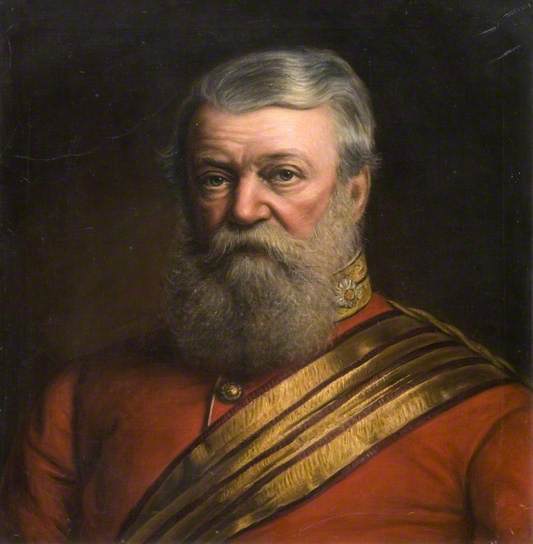
Photo of Yorke Moore accessed 10-09-2015 from http://www.bbc.co.uk/arts/yourpaintings/paintings/major-general-william-yorke-moore-18061890-59797


Ex: Sir Hermann Weber (1823-1918) Collection, # 1984 (cf. plate photo below)


Sir Hermann D. Weber


Ex: Roberto Allatini (ca. 1856-1927) Collection, not part of the Ars Classica XIII Sale of June 1928. Allatini was a member of a prominent Jewish family from Salonika [son of Dr. Moshe Allatini (d. 1882)] and was made a Fellow of the RNS in 1907.

Ex: Col. R. K. Morcom (1877-1961) Collection

Ex: Christopher Morcom Collection, CNG 76:272 (12 September 2007) “Christopher Morcom Collection of pedigreed Coins of Greece and the Aegaean Islands.” (with Morcom’s tag denoting the coin’s Weber pedigree). As an aside, this Christopher Morcom is the nephew of the Christopher Morcom who was Alan Turing's friend in school until Morcom's death in 1930.


Christopher Morcom, QC 


Ex: CNG
Acquisition: 2008
Tantalus ID#35539
plate photo from the Weber Collection Catalogue Vol. II, #1984

20080124

Greece/Aeolis; Kyme BCE 350-250


AE 10 (10 mm, 0.9 g)

O: Eagle standing r.
R: K - Y Vase.

cf. Aulock 1625 and 7693; SNG Cop. 41ff; BMC 106, 16ff; SNG Tübingen 2690ff; GCV 4186.

Ex : Gerhard Rohde ; Köln, Germany

Acquisition: 2008

Greece/Aeolis; Kyme BCE 480-450


AR Hemiobol (8.6 mm, 0.38 g).

O: eagles hd r KY (to left)
R: mill sail incuse

BMC 105, 10; GCV 4174 v.
Ex: Gerhard Rohde ; Köln, Germany
Acquisition: 2008

20080112

Iran/Sassanian Two Examples

Khushro Anurshivan CE 531-579


AR Drachm, 31 mm, 3.71 g, mint MY=Meshan in S. Iraq
Year 45 =c. CE 575
O: hd of Shah r.
R: Fire altars and attendants


Ex: Windsor Antiquities NY
Acquisition: 2005


Iran/Sassanian; Yazdgard III  CE 632-651

AR Drachm 3.45 g., 23 x 33 mm, Sakastan mint Yr. 3, CE 634-635 

O : corrupted legend that reads « Long Live Yazdgard »
/
R:fire altar with two attendants,  SK , see Pahlavi example  above right. (on right on coin). Dated Yr. 3 on left in Pahlavi that reads as noted above on the left.   
 

Large chip from 3-5 o’clock and a large flan crack of about 10 mm in length from 4 o’clock pointing towards but never reaching 11 o’clock.

Acquisition: 2010


Iran/Sassanian


Kavad, 2nd reign CE 499-531

AR Drachm, 27.5 mm, 3.76 g, mint AS in Khuzistan(?)
Year 27 or 37(?) =c. CE 507-519
Göbl 187
O: hd of Shah r.
R: Fire altars and attendants

Ex: Amphora/D. Hendin
Acquisition: 2005

Greece/Thessalian League BCE 196-146

AE 17 mm, 3.05 g
GCV 2237 v

O: Hd of Athena r in crested Corinthian helmet, IΠΠAI/[TAΣ] above and beneath.
R: ΘΕΣ/Σ/[ΑΛΩΝ] above and below horse trotting r

Ex: J. Jencek
Acquisition: 2006

Gordian III CE 238-244

AE Sestertius, 33 mm, 22.68 g, Rome mint, CE 243-244

O: laur bust r. IMP GORDIANVS PIVS FEL AVG
R: Gordian stg r, PM TRP VI COS II PP SC

Ex: Amphora/D. Hendin

Acquisition: 2004