20130616

Greece/Seleucid; Antiochus II Theos BCE 261-246


AE 20 mm 6.63 g., 5h,  Antioch mint


SC 575.1a  WSM 982

O: laur. hd of Apollo r., hair rolled behind, a few wavy locks escaping down neck, dotted border.

R: BAΣΙΛΕΩΣ on right  ANTIOXOY on left,  tripod. Anchor r., in ex. 
controls outer right and left placed sideways.

ex: Dan Clark Auction 4 (1984) lot 226

Greece/Cappadocia; Ariobarzanes I BCE 95-63


AR Drachm; 16 mm, 4.05 g, 12h. Yr 29=BCE 67-66

Simonetta 40b


ex: Heritage Auction 3020 (6-11 Sept 2012) portion of lot 25819

20130427

Greece/Seleucid; Antiochos II Theos BCE 261-246


AE 18 mm 3.92 g., Tarsus mint


SC 565  WSM 1313

O: dioscuri on horseback r, dotted border

R: BAΣΙΛΕΩΣ on left  ANTIOXOY on right Athena stg r on anchor l., brandishing spear and shield.

Greek/Thrace; Lysimachos BCE 305-281


AR Drachm, 17 mm, 3.94 g, Ephesos mint c. BCE 294-287

Essays Robinson, Thompson 170var (monogram on throne). rare example

O: diad hd of deified Alexander r wearing horn of Ammon

R: ΒΑΣΙΛΕ[ΩΣ]  on right [ΛΥΣ]IMAXO[Y] on left Athena Nikephoros seated left, spear behind; tripod to inner left, Φ on throne.

Greece/Seleucid; Antiochos VII Sidetes BCE 138-129; Unpublished Control from the mint of Tyre


AR Tetradrachm, 28 x 25 mm, 14.21 g, Tyre mint SE 175=BCE 138/7

SC 2109.3Ad, SCADS 58 (this coin)

O: diad draped bust of Ant r, diad ends falling straight behind dotted border
R: ΒΑΣΙΛΕΩΣ  curving on r., ANTIOXOY curving on l., round, eagle stg l., on ship’s ram, palm branch under far wing dotted border.

Mintmarks: A/PE above TYP monogram on club in l. field. AΣ in r field above, EOP (date). Unpublished control between eagle legs.


enlargement of the control which appears to be Phoenician rather than Greek


Update 11 November 2017


It appears after some time that a similar tetradrachm from the mint of Tyre has come to market. This example likely clarifies the control as being Greek not Phoenician but nevertheless previously unrecorded as is the new example which differs from the above example in the horizontal rendering of the control rather than vertical:


enlargement of the photo followed by a close up of the control:
 

The difference is the rendering of the cursive Omega, on the example published above in the vertical rendering the link is missing on the right, in this horizontal example it is missing on the left. Both pieces were minted in the same year and therefore it can be concluded that the same magistrate signed both. This coin adds another control variety to the series for Antiochus VII from Tyre.

Greece/Seleucid; Seleucus III


Edward I Penny from the Colchester Hoard 1969


PLANTAGENET. Edward I. 1272-1307. AR Penny (18mm, 1.49 g, 11h). In the name and types of Henry III. Long Cross type, class VI. Bury St. Edmunds mint; Ion, (John de Burnedisse) moneyer. Struck 1272-1278. Crowned facing bust; scepter to left / Voided long cross; trefoils in quarters. North 1001; SCBC 1377

From the Ridgegate Collection. Purchased from P. Minns, April 1971. Ex Colchester Hoard, 1969.

for more info regarding the Colchester Hoards, please refer to this URL
https://www.yorkcoins.com/colchester_hoards_of_voided_long_cross_pennies.htm

During late July 2017, I visited the Tower of London and came across the following display in the "Mint" which has a very interesting history of the Tower Mint on display with numerous examples of coins minted there from Medieval times towards the early 18th Century. The exhibit is found of course on "Mint Street". The display discussed the Colchester Hoard:

 
The actual lead canister had a height of 235 mm.
 
Photo of coins on display from the Colchester Hoard

A book I obtained during a visit to the British Museum by Eleanor Ghey, Hoards; Hidden History published by the British Museum Press in 2015 discusses the Colchester Hoard on pp. 101-103. The 1969 hoard consisted of 14,065 coins and was made up of two batches dated 1256 and then 1268-78. Of interest regarding the coin illustrated above from Bury St. Edmunds, is noted "The latest batch was a small 'top-up' of about 2,000 freshly struck coins from the nearest local medieval mint at Bury St. Edmunds, which had been placed in the top of the container. This indicates several episodes of hoarding by the same individual(s) rather than a one-off event. The lead canister is likely to have been made especially for this purpose. It was almost full, but had it been so it would have just accommodated a volume of coins up to the value of 100 marks (a commonly used unit of account for larger sums). The amount of money involved equates to tens of thousands of pounds in modern terms and it is likely that it was held by someone involved in sizeable financial transactions as part of their business dealings, such as a merchant or a banker." (pp. 102-3).

20130316

Greek/Seleucid; Antiochus IX Philopator BCE 114/3-95


AE 14 mm, -- g, --h, Antioch mint, BCE 113-112

SC 2365 var

O: hd of bearded Herakles r. in lion skin headress, dotted border.

R: ΒΑΣΙΛΕ[ΩΣ] ANTIOX[OY] in two lines on r., ΦΙΛΟΠAT on l., club.

20130308

20121026

Greek/Seleucid; Alexander I Balas BCE 152-144


AE 20 mm Serratus,  8.04g, Antioch mint,  c. BCE 147/6

SC 1793.4, CSE 195, HSC 900 (R1-2) 

O: Diademed hd of Alexander I r, dotted border.

R: ΒΑΣΙΛΕΩΣ on r ΑΛΕΞΑΝΔΡΟΥ on l. Athena stg l holding Nike and grounded shield, spear behind.   

Controls inner left monogram K above star and Δ


Anglo-Saxon England/Northumbria; Eanred CE 810-841

AR Styca ( mm,   g,  h).  Eoferwic (York) mint; Huaetred, moneyer. Struck 810-circa 830. 

North 186; SCBC 860.

O: + EANRED REX, short cross pattée 
R: + HVAETRE[D], short cross pattée.     

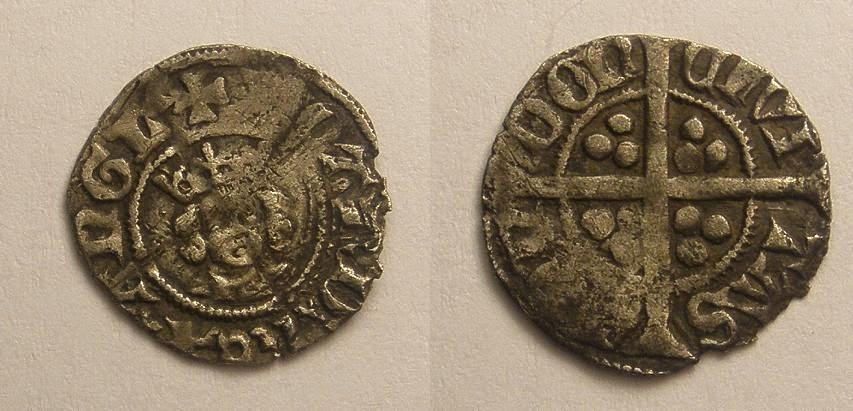
England; Plantagenet/Richard II CE 1377-1399


Halfpenny, intermediate style, London Mint, facing crowned bust within circle, rev. long cross pattee, trefoils of pellets in angles,  g., S.1699

GREECE/Seleucid; Antiochus VIII Grypus BCE 121/0-96


AR Tetradrachm, 30.43 mm, 16.47 g, Sidon mint  Year 197/BCE 116/5

 SC 2330.2, SNG Spaer 2577-78, HSC 1197g (R2), BMC 8, Babelon 1387-8

O: diad hd r, diad ends falling straight behind, fillet border.

R: BAΣΙΛΕΩΣ ANTIOXOY in two lines on rt EΠΙΦΑΝΟΥΣ on left, Zeus Uranios standing left, crescent above head, holding scepter in left hand, star above extended right hand, slightly double struck. Mintmark on outer left ΣΙΔΩ/IEP/AΣ, above control with date in ex. 

Pennies from the Collection of Andrew Wayne

PLANTAGENET. Henry III. 1216-1272. AR Pennies. All coins: Long cross type. Class Vc. Canterbury mint; Moneyers: Ion, Robert, and Willem. Struck 1251-1272. Crowned facing bust, holding scepter / Voided long cross pommée, with pellet at center and three pellets in angles. North 993; SCBC 1369. lightly toned, a few minor areas of flat strike, third struck slightly off center.  

From the Andrew Wayne Collection. Ex Dix, Noonan, Webb 69 (15 March 2006), lot 1343 (part of).

Ex CNG EA 279:889 (16-05-12)

PLANTAGENET. Edward II. 1307-1327. AR Penny (19mm, 1.34 g, 1h). Class XIa1. London mint. Struck circa late 1310-circa 1314. Crowned facing bust / Long cross pattée, with three pellets in angles. SCBI 39 (North), 768-71; North 1060/1; SCBC 1455.  

From the Andrew Wayne Collection (purchased privately from Mike Vosper, August 1997).

Ex CNG EA 279:950 (16-05-12)

20120708

Archaeologists Uncover Gold Treasure Near Herzliya (Israel)

http://www.israelnationalnews.com/News/News.aspx/157609#.T_nIpGukd8E

I first visited Apollonia/Arsuf , 25 years ago and remember picking up small shards of polished emerald green glass in the surf that proved to be waste products from a Byzantine glass factory active in the 5th-8th centuries CE (or thereabouts). Also, climbing on the Crusader era breakers in the surf was fun as well. It would've been nice finding 101 gold coins, but better the archaeologists found it. I've been back to this beach area a few times since and hope that the Mosque of Sidna 'Ali is undergoing preservation work as well.

http://www.foxnews.com/scitech/2012/07/10/gold-coins-from-time-crusades-found-in-israeli-ruins/?intcmp=features  update with great pix of the hoard and hoard in situ despite the numerous typos and the fact that it hails from Faux News.  The pix are the best part.

20120613

England; Henry III CE 1216-1272


AR Penny, 1.48 g, IIIb, Moneyer: Willem Mint: Oxford, c. CE 1248-1250
North 987, S. 1363
O: henricvs Rex III
R: WILLEM ON OXON  [William Sarsorius]

Regarding the moneyer, Charles Lewis Stainer writes in his Oxford Silver Pennies from AD 925-AD 1272, Vol. 46, p. xxvi (1904) "Of William Sarsorius I have not much information. He is evidently the same person as William Le Saucer, who was Mayor of Oxford about AD 1258-1259, and signs in that capacity to a deed (St. Aldate, 49) of the Hospital of St. John, now among the monuments of Magdalen College."