AE "Assarion" 17 mm, 1.97g, 12h
AMNG 1382 variety ICTPΩ
O: [------CEYH]POC, laur. hd rt.
R: NIKOΠOΛIT ΠPOC ICTP, Aesculapius stg facing hd left holding caduceus
20150208
ROMAN/Gordian III CE 238-244 Fortuna Redux with anchor?
AR Antoninianus, 26 mm, 4.02 g, 6h, Antioch Mint CE 243-244
slightly double struck obs on oversized flan,
RCV 8613
RSC 98a
RIC 210
RSC 98a
RIC 210
O: IMP GORDIANVS PIVS FEL AVG
R: FORTVNA REDVX, Fortuna std l, holding cornucopia in her left arm and an anchor with her right hand.
It should be noted that what has been described in all the sources related to this particular depiction is that Fortuna is holding a rudder as she had been depicted in the past. In this particular coin it is clear that she is holding what appears to be an anchor. A Seleucid style anchor at that. Maybe due to the fact that the Emperor and his army relieved Antioch from a Persian threat, the anchor symbol so long associated with the history of the region was utilized at this time to specify that the returning good fortune is specifically Antioch's?
Note the detail on the rudder as depicted in this photo obtained from the net of a denarius of Geta. Either the celator was just taking a short cut in his depiction or in fact he was depicting an old symbol familiar to the region.
It should be noted that what has been described in all the sources related to this particular depiction is that Fortuna is holding a rudder as she had been depicted in the past. In this particular coin it is clear that she is holding what appears to be an anchor. A Seleucid style anchor at that. Maybe due to the fact that the Emperor and his army relieved Antioch from a Persian threat, the anchor symbol so long associated with the history of the region was utilized at this time to specify that the returning good fortune is specifically Antioch's?
Note the detail on the rudder as depicted in this photo obtained from the net of a denarius of Geta. Either the celator was just taking a short cut in his depiction or in fact he was depicting an old symbol familiar to the region.
20150207
A Small Selection of the Votive issue of Julian II CE 361-363
All inscriptions are as described here:
O: DN FL CL IVLIANVS PF AVG, helmeted cuir., diad., bust left with shield and spear
R: VOT/X/MVLT/XX within a wreath, mm in ex.
RIC 421 mm appears to be palm branch then officina mark followed by SISC with a dot, though the initial portion is obscured.
RCV 19171
AE 3, 19 mm, 2.68 g, 11h, Sirmium mint c. 362-363
mm, BSIRM
RIC 108, RCV 19172
AE 3; 20 mm, 2.96 g, 12h, Constantinople mint c. 362-363
mm branches on either side CONSPA
RIC 166 (Scarce), RCV 19176
AE 3; 20 mm, 3.29 g, 11h, Heraclea mint c. CE 362-363
No Spear variety****
mm HERACL*A
RIC 106, RCV 19174
AE 3; 19 mm, 2.66 g, 11h, Antioch mint c. CE 362-363
mm ANTΔ
RIC 219 (Rare), RCV 19181
AE 3; 20 mm, 3.57 g, 5h, Antioch mint c. CE 362-363
mm branches on either side of SMANTΓ
RIC 221 (Rare), RCV 19182
ISLAMIC/India; Malwa Sultanate; 1401-1531
Two examples of square Fulus minted between 1500-1531 by the last members of the Khilji Dynasty.
Nasir ud-Din Shah CE 1500-1511
AE Square Fals, 18 mm (4mm thick), 10.61 g, 9 h, NM dated AH 914/CE 1508-1509
Goron-Goenka M140 v.
O: Nasir Shah al-Khilji/bin Ghiyath Shah
R: as-Sultan bin as-Sultan 914
Mahmud Shah II CE 1511-1531
AE Square Fals, 12mm (3mm thick), 4.08 g, 9h, NM, ND
O: Mahmud Shah al-Khilji/bin[-----]
R: as-Sultan bin as-Sultan
Nasir ud-Din Shah CE 1500-1511
AE Square Fals, 18 mm (4mm thick), 10.61 g, 9 h, NM dated AH 914/CE 1508-1509
Goron-Goenka M140 v.
O: Nasir Shah al-Khilji/bin Ghiyath Shah
R: as-Sultan bin as-Sultan 914
Mahmud Shah II CE 1511-1531
AE Square Fals, 12mm (3mm thick), 4.08 g, 9h, NM, ND
O: Mahmud Shah al-Khilji/bin[-----]
R: as-Sultan bin as-Sultan
20150206
BRITAIN; Tudor; Mary CE 1553-1558
I have been reading Peter Ackroyd's TUDORS, the second volume of his history of Britain. The first volume FOUNDATION was a quick and interesting read and I certainly enjoyed his inclusion of important social history info that placed the recitation of royal and noble facts in proper perspective. TUDORS is dominated by a discussion of the Reformation for the first 300 pages. I am only now entering the early Elizabethan period in the text. If you can get past the beheadings and the burnings and the disputes about religious minutia it's a good read.
Here are two pieces related to "Bloody Mary" from her short reign:
AR Groat, 24 mm, 1.81 g, 3h
London, CE 1553-1554
SCBC 2492
N. 1960
Pomegranate privy mark
O: MARIA D G ANG FRA Z HIB REGINA crowned bust left
R: VERITAS TEMPORIS FILIA long cross fourchee over royal shield
AR cut Groat, 22 x 12mm, 0.87g, 9h, London ,
CE 1554-1558
SCBC 2508
N. 1973
Lis privy mark
O: PHILIP Z [MARIA D G REX ET R]EGI crowned bust of Mary left
R: POSVI[MVS DEVM ADIV]TO NOS cross fourchee over royal shield
from the patina it appears that this piece was cut at sometime in the past. It would be interesting to hear from anyone who has encountered similar cut groats, particularly from a time when half groats were being minted (though considering their respective catalogue prices, there may have been a shortage of half groats that caused groats to be cut for smaller change.)
20150106
ISLAMIC/Bahri Mamluks; an-Nasir Muhammad I AH 709-741/ AD 1310-1341
AR Fractional Dirham, 16mm, 1.84 g, 1h, no visible mint or date
Album 921 (R)
Balog 212
O: Sultans names and patronymic
R: Kalima
Note found on dealer site:
Album 921 (R)
Balog 212
O: Sultans names and patronymic
R: Kalima
Note found on dealer site:
The rare fractional dirhams were minted with the technique of the Fatimid “black” dirhams.
They were struck on insufficiently heated pieces cut from a narrow silver ribbon.
The resulting coins vary in size and weight with only the center portion of the
legends on the flan and virtually always lacking the mint and date.
20150105
ISLAMIC/Syria; Ayyubid; al-'Adil Sayf ad-Din الملك العادل سيف الدين أبو بكر بن أيوب CE 1196-1218/AH 592-615
AR Dirham; 3.01 g, 20mm, 9h, Damascus mint, c. AH 601/ c. CE 1204-1205
Balog 285 type
Album 803
Festooned double trefoil design obs & rev.
O: Border segment is not visible but should read "duriba/bi-D/imashq/sanna/ahd wa/sittami'yah"
Center: "ad-Din/al-Malik al-'Adil/Abu Bakr bin Ayyub/Sayf"
R: Border segment not visible but should contain the Shahada
Center: "al-Mu'/al-Imam an-Nasir/li-Din Allah Amir/minin"
ISLAMIC/Syria; Ayyubid; al-Kamil Muhammad I CE 1218-1238/AH 615-635
AR Half Dirham, 1.47g, 13 mm, 5h, Dimashq/Damascus mint, c. CE 1218-1225/AH 615-622
Balog 440 type
Album 814.1
O: border top "duriba bi-D" border left [imashq sannah] border bottom [------] border right "sittama'yah"
Center: "Al-Malik/Al-Kamil"
R: Border Shahada mostly visible on this piece.
Center: "Al-Imam/An-Nasir"
20150103
Greece/Seleucid; Antiochus III BCE 223-187
AE 20 mm (Denom. B), 8.49 g, 12h, Seleucia on the Tigris mint c. BCE 220-215
bevelled edge on obverse.
SC 1171
ESM 237
O: diad hd of Antiochus r with young features and hair in bangs over forehd, dotted border.
R: BΑΣΙΛΕΩΣ on r and ANTIOXOY on l., Nike stg l holding palm branch dotted border.
control visible outer right not visible on outer left but no reason to suspect it is different from that mentioned in SC.
This example is about 0.8 grams heavier than the high end of the published weight range.
considered R2 in Hoover.
This example is about 0.8 grams heavier than the high end of the published weight range.
considered R2 in Hoover.
20141223
An Important Philatelic Aside...for 2015
175th Anniversary of the Penny Black, first adhesive postage stamp
1840-2015
In the coming year, philatelists and perhaps others (such as myself) will be marking the 175th anniversary of the first adhesive postage stamp, issued in the UK on 6 May 1840. The above example is from my personal collection and is the second example that I've owned in 45 years of collecting stamps. Though I don't collect stamps as actively as I used to, I did hang on to this example after selling the majority of the collection a number of years ago.
Classics such as the Penny Black and other issues from the 19th and early 20th centuries will always be in demand from collectors. The dwindling nature of letter writing, general correspondence and the mails themselves have changed so much in the last twenty years the necessity of stamp usage and the collecting of these items have decreased dramatically. It's sad to think that such a great hobby that entertained and educated so many generations of all classes of people over the years prior to the late twentieth century has fallen on difficult times. Perhaps stamp collecting will experience a renaissance someday, maybe even before the bicentennial in 2040. I thought it would be nice to step away from my other collectible interest for a moment to pay homage to what in historical terms is the recent past and present a hope for the future of another great hobby.
20141220
CHINA; Later Zhou (后周) Dynasty (Five Dynasties Period) CE 951-960
Shizong CE 954-959
AE Cash after CE 955
O: Zhou Yuan tong bao
R: plain
Sch. 414
H. 15.12
According to Hartill, these coins were cast from melted-down bronze statues from Buddhist temples. "When reproached for this, the Emperor uttered a gnomic saying to the effect that the Buddha would not mind this sacrifice. It is said that the Emperor himself supervised the casting at the many large furnaces at the back of the palace. The coins have amuletic properties because they were made from Buddhist statues, and are particularly effective in midwifery--hence the many later-made imitations." (Hartill, Cast Chinese Coins, p. 114)
CHINA; A Small Selection of Northern Song (北宋) Dynasty Cash CE 960-1127
Zhenzong CE 998-1022
O: Xien Ping yuan bao CE 998-1003
R: plain
Sch. 469
H. 16.43
Renzong CE 1022-1063
O: Huang Song tong bao CE 1039-1054
R: plain
H. 16.103
Yingzong CE 1064-1067
O: Zhi Ping yuan bao (clockwise Seal Script) CE 1064-1067
R: plain
H. 16.156
Shenzong CE 1068-1085
O: Yuan Feng tong bao (clockwise Running Script) CE 1078-1085
R: plain
H. 16.235
Zhezong CE 1086-1101
O: Yuan You tong bao (clockwise Seal Script) CE 1086-1093
R: plain
H. 16.261
20141219
CHINA/Yuan Dynasty (元朝) CE 1279-1368
Wuzong (Khaishan) CE 1308-1311
Zhi Da tong bao 1310-1311
AE cash 3.58g, 23mm
H-19.39, S-1098, FD 1723
Ex: Arthur Hummel Sr (1884-1975) Collection
20141213
ISLAMIC/Ilkhanid; Arghun AH 683-690 / CE1284-1291
AR Dirham, 22 mm, 2.43g, Tabriz mint, AH 684/CE 1285-1286.
Album 2146
O: shahada in square, mint above.
R: Uighur inscription, with Arghun in Arabic at the bottom field.
image obtained from: http://altaycoins.com/makaledetay.asp?dil=Mg==&id=MjI=
This site provides an excellent intro to Ilkhan coins and how to read them if you don't already know how.
The Uighur inscription indicates that this coin has been struck under the authority of Arghun Khan. The Great Khan at this time who is unnamed here is Kublai Khan CE 1260-1294.
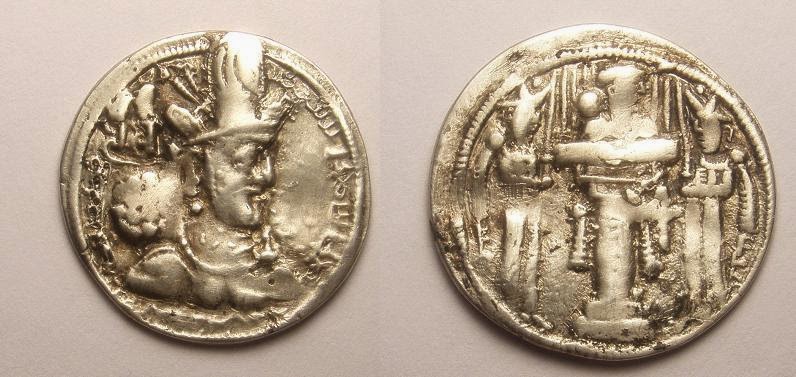
IRAN/Sassanian; Shapur II CE 309-379
AR Drachm, 24 mm, 3.28 g, nd nm legible Gobl 102
O: bust right in merlon crown Pahlavi inscription around.
R: fire altar surmounted by bust of Ahura Mazda in flames with attendants on either side.
inscription on altar and to either side of attendants.
Ex: FSR MBS 84 lot 424 (April 2012)
20141212
China/Northern Song (北宋) Dynasty; Zhezong CE 1086-1100
AE large Cash, Yuan Fu era CE 1098-1100 seal script
H. 16.335, FD 1010, S 604
O: Yuan Fu tong bao
R: plain
purchased at the LanSu Chinese Garden, Portland OR in 2013
CHINA/Ming (明) Dynasty; Emperor Sizong (Chongzhen) CE 1628-1644
AE Cash
Hartill 20.292
S. 1226-1229 v
O: Chong Zhen tong bao
R: plain
Purchased at China Treasury Antique Gallery, 61, Shamian Main St., Guangzhou, PRC for RMB 10 (USD 1.22) in 2002.
Greece/Seleucid; Antiochus IX Philopator c. BCE 114/3-96/5
AR Hemidrachm, 1.82 g, 13 mm, 12h, Antioch mint, c. BCE 96/5
SC 2371, Hoover 1241 (R2)
O: diademed hd of Antiochus IX r, clean shaven, diadem ends falling straight behind, dotted border.
R: [ΒΑΣΙΛΕΩΣ AN]TIOXOY in two lines on r., [ΦΙ]ΛΟΠATPOPOΣ on l., Nike advancing l., holding wreath. Controls E/A/Π outer l., field.
Subscribe to:
Posts (Atom)