AE 2 5.66g, 22 mm, 12h, Cyzicus mint CE 383
RIC Cyzicus 14a
RCV 19999
O: helmeted dr, cuir bust r holding spear and shield, DNGRATIA--NVSPFAVG
R: Gratian helmeted and in military attire stg l on galley hd r his r hand raised, Victory seated at helm, mint mark SMKA in ex, with wreath in field to left of Gratian. GLORIARO--MANORVM
Ex: W. Esty
Ex: Berk
AN XLVIII
20180508
20180424
ROMAN EGYPT/Antoninus Pius CE 138-161
AE Drachm,
33 mm, 25.68 g, 12h, Alexandria mint, Regnal Year 8/CE 144-145
Emmett 1668
var.
Köln 1468 var.
O: laur
draped bust right, AVTKTAIΛAΔP/ANTωNINOC
R: Serapis
std l inside a temple, L H
ROMAN EGYPT/Antoninus Pius CE 138-161
AE Drachm,
34 mm, 20.64 g, 11h, Alexandria mint, Regnal Year 13/CE 149-150
Milne 2054
var.
Emmett 1621
var.
O: laur
draped bust right, AVTKTAIΛAΔP/ANTωNINOCCEBE/VC
R: Serapis
std l inside a temple, TPICKAIIς
The Greek "16" after the date is supposed to have recorded the number of Cubits the Nile rose that year, 16 cubits being 7.315 meters or 24 feet which appears to be about average for lower Egypt.
Ex: CNG 418 (11 April 2018) portion of lot 662
The Greek "16" after the date is supposed to have recorded the number of Cubits the Nile rose that year, 16 cubits being 7.315 meters or 24 feet which appears to be about average for lower Egypt.
20180321
Greece/Seleucid; Seleucus II Callinicus BCE 246-225
AR Tetradrachm, 30 x 27 mm, 17.09 g., 11h, Uncertain Mint 40 probably in Commagene,
SC C727.5 (control below arrow) (R1 according to
Hoover but more like R2 based upon census).
O: diad hd of Seleucus II r. dotted border.
R: BAΣIΛEΩΣ
on r., ΣEΛEYKOY on l., Apollo stg l., testing arrow and resting l. elbow on
tripod. Control on outer left NA below arrow. Reverse is double struck and obverse depicts
die abnormalities that are discussed in SC.
Likely Ex: Commerce "Seleucus III" Hoard 2002, as 10 of this
variety were part of that hoard with die axes the same as this example. Hoard consisted of approximately 6,500 AR pieces and had a closure around BCE 225/4.
Ex: VAuctions/Triskeles Auctions, Sale 315, Lot 73 (closed 23 April 2015)
A similar example from the same dies was recently sold by CNG:
Ex: VAuctions/Triskeles Auctions, Sale 315, Lot 73 (closed 23 April 2015)
A similar example from the same dies was recently sold by CNG:
Auction 421 lot 282 (closed 30 May 2018)
AR Tetradrachm 29.8 mm, 16.78 g and 12h.
Ex: the MNL Collection. & Freeman & Sear Inventory, no. G4043
Greece/Seleucid; Alexander I Balas BCE 152-145
AE 21 mm, 7.47 g., 12h Apamea on Orontes mint, SE
163 (BCE 150-149) without countermark
SC 1804a (control is similar to symbol for Phoenician
deity Tanit) (R2)
O: diad hd of Balas r.
R: AΠΑΜΕΩΝ, Zeus stg l holding a Corinthian helmet
and resting on a scepter, helmet above
date ΓΞΡ, see above re control.
20180225
GREEK/Nabataean; Aretas IV, with Shaqilat. 9 BCE-CE 40.
AR Drachm (12mm, 3.49 g, 12h). Petra mint. Dated RY?
Cf. Meshorer, Nabataea 111
DCA 975
O: Laureate head of Aretas right Aramaic inscription "Aretas, King of the Nabataeans, lover of his people"
R: Jugate busts of Aretas, laureate, and Shaqilat, draped, Aramaic inscription and RY off flan. "Shaqilat Queen of the Nabateans, Year---"
20180203
ISLAMIC/Zanzibar Sultanate; Sultan Barghash ibn Sa'id 1870-1888
AE Pysa, AH 1304/CE 1886
KM# 7 18,680,000 minted
O: زنجبار
R: Scales with the AH year inscribed ١٣٠٤
20180125
Theodore V. Buttrey (1929-2018)
We were saddened to learn that Ted Buttrey passed away earlier this month. He had freely offered assistance to us in the past when we were in search of information for our minor research projects and he was extremely helpful and we greatly appreciated the generous time he gave to that information and our questions, particularly when it appeared no one else would come forward to assist.
We are grateful for the opportunity to correspond with him about these topics and will miss his assistance on those nagging questions that will arise in the future.
http://www.coinsweekly.com/en/News/Theodore-V-Buttrey-1929-2018/4?&id=5137&utm_source=newsletter&utm_medium=email&utm_campaign=CoinsWeekly+25.01.2018&newsletter=CoinsWeekly+25.01.2018
by Ursula Kampmann
translated by Christina Schlögl
January 25, 2018 – On 9 January 2018, the numismatist Theodore (Ted) V. Buttrey died, only 11 days after his 88th birthday. We have thus lost a committed coin enthusiast, who never retreated to an ivory tower. He was most likely the only numismatist whose research made it to all major American newspapers and whose TV shows were broadcast at over 75 TV stations. And since he was also a kind person who dedicated a lot of time to young researchers, he had a lasting impact on many of today's numismatists.
Buttrey also worked on numerous excavations and, among other things, published the coin finds of Sardes and Morgantina.
In addition, Buttrey was also a great expert on Mexican coinage. He published the “Guidebook of Mexican Coins” at Krause Publications in 1969.
Unfortunately this debate was not limited to an academic struggle for the truth. Buttrey publically accused the dealers who had been involved in the sale of knowingly deceiving their customers. Their answer to his accusations was a libel suit with $ 6 Mio as amount in dispute. The names of the involved parties did not just appear in the numismatic specialised press; many American media picked up on this spectacular dispute.
Buttrey was acquitted of all charges and the ingots were removed from the exhibition of the Smithonian, but the harsh tone o the debate split the American numismatic world for al long time.
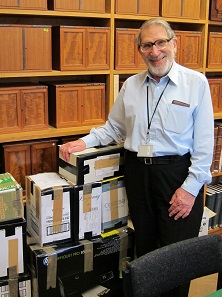
The author of this obituary was able to meet him in person at this domain. He did not just proudly show her the enormous library of auction catalogues, but also the mailing list of the huge network he had built in order to give any occurring duplicates to other academic institutions. The renowned scholar personally packed all the parcels with catalogues, which were sent as part of this exchange and most of the time he himself also paid for postal charges.
Both his modesty and his unbroken interest in the academic work of others deeply impressed me. In conversation, he would always seem like a dearly beloved grandfather, eagerly listening to his grandchild, but only until he would find an error in reasoning. There was no alternative then: He had to explicitly reveal the error.
Ted Buttrey is survived by four children from his first marriage and by his third wife, whom he married in October 2017. We are in mourning for a man who did not just love numismatics but who also loved people.
I was fortunate enough to meet Ted Buttrey for the first time in 2011 during my visit at the Fitzwilliam Museum. If you would like to have a look at his last domain, please click here.
In 2012, CoinsWeekly reported on Ted Buttrey receiving the Wolfgang Hahn-Medal of the Vienna Institute of Numismatics and Monetary History. You can read the article here, though only in German.
You can find the extensive article on the gold ingots debate of the New York Times here.
Theodore Buttrey was always a keen thinker, who reviewed and disproved centuries-old prejudices, just like in his article about the Spintria that were wrongly claimed to be brothel tokens, which was the base of this article.
We are grateful for the opportunity to correspond with him about these topics and will miss his assistance on those nagging questions that will arise in the future.
http://www.coinsweekly.com/en/News/Theodore-V-Buttrey-1929-2018/4?&id=5137&utm_source=newsletter&utm_medium=email&utm_campaign=CoinsWeekly+25.01.2018&newsletter=CoinsWeekly+25.01.2018
Theodore V. Buttrey (1929-2018)
by Ursula Kampmann
translated by Christina Schlögl
January 25, 2018 – On 9 January 2018, the numismatist Theodore (Ted) V. Buttrey died, only 11 days after his 88th birthday. We have thus lost a committed coin enthusiast, who never retreated to an ivory tower. He was most likely the only numismatist whose research made it to all major American newspapers and whose TV shows were broadcast at over 75 TV stations. And since he was also a kind person who dedicated a lot of time to young researchers, he had a lasting impact on many of today's numismatists.

Ted Buttrey at his last domain: The coin cabinet of the Fitzwilliam Museum in Cambridge. Photo: UK.
Ted Buttrey and the first Summer Seminar of the ANS
Theodore V. Buttrey was born on 29 December 1929 in Havre, Montana with a silver spoon in his mouth. His grandfather Frank A. Buttrey had created a little family empire with his department store chain “Buttrey Food and Drug”. But Ted Buttrey decided to study something he was passionate about from very early on: In 1946 he completed his Classical Studies degree with magna cum laude at Phillips Exeter Academy. Afterwards he went to Princeton. In 1952, he took part in the first numismatic Summer Seminar the ANS ever organized. This event has sparked young people’s passion for numismatics for more than half a century. Ted Buttrey was one of them. He earned his PhD in 1953 with his dissertation “Studies in the Coinage of Mark Anthony”, which was published in the ANS Museum Notes of 1954 in an abridged version.Academic career
After his graduation, Ted went to Yale, and did not just climb the academic ladder but also curated the numismatic collection between 1962 and 1964. He switched to the University of Michigan in Ann Arbor in 1964, where he was promoted to tenured professor in 1967 and served as director of the Kelsey Museum of Archaeology from 1969-1971.Academic interests
Ted Buttrey published more than 100 books and articles, with the ancient world as his main focus. His first comprehensive monograph was dedicated to the “Triumviral Portrait Gold of the Quattuorviri Monetales of 42 B. C.”. He might be best known for the second volume of the RIC, newly edited in 2007, in which he and Ian Carradice created a catalogue of the coinage of the Flavian dynasty.Buttrey also worked on numerous excavations and, among other things, published the coin finds of Sardes and Morgantina.
In addition, Buttrey was also a great expert on Mexican coinage. He published the “Guidebook of Mexican Coins” at Krause Publications in 1969.
The scholar and his greatest debate
Ted Buttrey got in the public eye when he declared that the Mexican gold ingots, which had been given to the Smithonian Institution as part of the Josiah K. Lilly Jr. collection in exchange for tax incentives in 1966, were in fact fakes. In 2000, their value would have amounted to roughly $ 75 Mio, if they had been real. Buttrey was able to provide academic proof that the counter marks on the dated ingots – a fact that itself was quite unusual for gold ingots from this period – did not match the denoted date.Unfortunately this debate was not limited to an academic struggle for the truth. Buttrey publically accused the dealers who had been involved in the sale of knowingly deceiving their customers. Their answer to his accusations was a libel suit with $ 6 Mio as amount in dispute. The names of the involved parties did not just appear in the numismatic specialised press; many American media picked up on this spectacular dispute.
Buttrey was acquitted of all charges and the ingots were removed from the exhibition of the Smithonian, but the harsh tone o the debate split the American numismatic world for al long time.

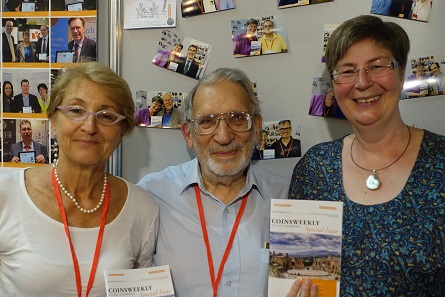
Theodore Buttrey also read CoinsWeekly. We last met him in 2015 on occasion of the International Numismatic Congress in Taormina. He posed for the photo wall of CoinsWeekly, together with Lucia Travaini. Photo: Björn Schöpe.
Buttrey as a TV star
Theodore Buttrey knew how to spark the public's interest in an academic subject. He used this talent in cooperation with the Television Center of the University of Michigan to shoot a number of TV series, mostly about the ancient world. This included 10 half-hour episodes about the Iliad, just to name one example. Part of the material was broadcast in over 75 TV stations.Buttrey in Cambridge
After his retirement in 1985, Ted Buttrey moved his main place of residence to Cambridge. From 1988 until 1991 he worked there as curator of the Fitzwilliam Museum. Starting in 2008, he filled the position on a voluntary basis. In this capacity, among other things, he created the probably largest collection of auction catalogues world-wide.The author of this obituary was able to meet him in person at this domain. He did not just proudly show her the enormous library of auction catalogues, but also the mailing list of the huge network he had built in order to give any occurring duplicates to other academic institutions. The renowned scholar personally packed all the parcels with catalogues, which were sent as part of this exchange and most of the time he himself also paid for postal charges.
Both his modesty and his unbroken interest in the academic work of others deeply impressed me. In conversation, he would always seem like a dearly beloved grandfather, eagerly listening to his grandchild, but only until he would find an error in reasoning. There was no alternative then: He had to explicitly reveal the error.
Ted Buttrey is survived by four children from his first marriage and by his third wife, whom he married in October 2017. We are in mourning for a man who did not just love numismatics but who also loved people.
I was fortunate enough to meet Ted Buttrey for the first time in 2011 during my visit at the Fitzwilliam Museum. If you would like to have a look at his last domain, please click here.
In 2012, CoinsWeekly reported on Ted Buttrey receiving the Wolfgang Hahn-Medal of the Vienna Institute of Numismatics and Monetary History. You can read the article here, though only in German.
You can find the extensive article on the gold ingots debate of the New York Times here.
Theodore Buttrey was always a keen thinker, who reviewed and disproved centuries-old prejudices, just like in his article about the Spintria that were wrongly claimed to be brothel tokens, which was the base of this article.
20180118
ISLAMIC/Palembang; Muhammad Badruddin II CE 1776-1804
Tin Piti, 0.69 g, 18mm. AH "1023" (misalignment should read 1203)/CE 1789
Robinson #9.33 (R2)
Inscription reads:
السلطان في بلد فلمبنغ سنة ١٠٢٣
Robinson #9.33 (R2)
Inscription reads:
السلطان في بلد فلمبنغ سنة ١٠٢٣
Photo from PALEMBANG COINS by Frank S. Robinson, page 11
20180105
ARMENIA; Cilician Armenia; Levon I (Լեւոն Ա Մեծագործ) CE 1198-1219
AR Tram, 22 mm, 3.03 g, 1h.
CCA 132 type
O: king std facing on throne, Levon King of the Armenians in Armenian around.
R: two lions rampant back to back with patriarchal cross between "by the will of god" in Armenian around.
GREECE/Thrace; Chersonesos c. BCE 386-338
AR Hemidrachm, 13 mm, 2.48g.
BMC Thrace p. 183, 8,9
McClean 4056
Deming 1301
SNG Cop 824-826
SG 1602
O: forepart of lion right with head left
R: quartripartite incuse pattern, with raised and sunken quarters, sunken quarters each contain a pellet.
GREECE/SELEUCID; Antiochos VII Sidetes BCE 138-129
SNG Lockett 3163
O: Diademed bust right
R: BAΣIΛEΩΣ ANTIOXOY on right, EYEΡΓETOY on left, Sandan
standing atop winged lion; monograms ΛY, with ME below, to outer left
Ex: Akropolis (Peter Burbules)
20171229
ROMAN/Crispus as Caesar CE 316-326
Bi Reduced Follis, 3.19 g, 20 mm, 12h, London mint CE 318
RCV 16720 variety
RIC VII London 143 variety
Cloke/Toone 8.11.033 (RR)
O: laureate, draped, cuir bust r. FL IVL CRISPVS NOB CAE
R: Sol stg left raising right hand and holding orb in left with drapery falling over left shoulder.
SOLI INVIC-TO COMITI. PLN in ex and crescent in left field.
with thanks to Lee Toone for the Cloke/Toone info.
20171216
ROMAN PROVINCIAL/Paphlagonia; Sinope/Geta as Augustus CE 209-212
AE 19 mm, 5.3 g, 6 h, dated 255 corresponding to CE 210.
Lindgren III, 165
RPC ID 84535 (this coin illustrating type) 2 known, though there are at least three by my census as of 2024.
O: laur., draped bust right [IMP CAES P SEP] GETA AV
R: Temple front of two columns, with female deity Nemesis (?) stg in center, [C I F SIN]O ANN
CC[LV] or as Lindgren described the coin "distyle shrine within which Nemesis stg l, r. (hand?) at mouth, l., holding cubit rule" (Lindgren III, page 10, the latter description is from ISEGRIM).
Lindgren also notes NISC "not in sources consulted and perhaps unpublished". Though it is now published in Lindgren (1993) though not found in any other sources nor recent auction records that have been consulted and therefore, possibly a rare or scarce piece.
with thanks to Pekka K and Mark Fox for the information related to the identification of this coin.
O: laur., draped bust right [IMP CAES P SEP] GETA AV
R: Temple front of two columns, with female deity Nemesis (?) stg in center, [C I F SIN]O ANN
CC[LV] or as Lindgren described the coin "distyle shrine within which Nemesis stg l, r. (hand?) at mouth, l., holding cubit rule" (Lindgren III, page 10, the latter description is from ISEGRIM).
Lindgren also notes NISC "not in sources consulted and perhaps unpublished". Though it is now published in Lindgren (1993) though not found in any other sources nor recent auction records that have been consulted and therefore, possibly a rare or scarce piece.
with thanks to Pekka K and Mark Fox for the information related to the identification of this coin.
20171207
GREEK/Seleucid; Demetrios II (First Reign) BCE 144-138
SC 1904
(this coin, also SC plate coin)
CSE 875
(this coin)
O: diad
hd right, fillet border.
R: BAΣIΛEΩ[Σ]/ΔHMHTPI[OY] in two lines on right.
ΘEOY/ΦIΛAΔEΛΦ[OY]/NIKATOPO[Σ]
in three lines on the left.
Date would appear
on inner right beneath control, it is possibly present but obscured by an area
of flatness.
Control, inner
right: ΣI
Ex:
Arthur Houghton (1940-) Collection, CSE 875 “from Lebanon/Beirut”
Plate
coin from SC II vol II (plate 26). Noted as “unique” in SC.
20171205
ROMAN/Maximianus CE 286-310
AE Post Reform Radiate, 3.18 g, 21 mm, 11h, Cyzicus Mint c.
CE 295-299
RCV 13315
O: rad cuir draped bust r IMP C M A MAXIMIANVS PF AVG
R: Maximianus on left receiving victory from Jupiter on
right CONCORDIA MI-LITVM with
Kϵ in
field between figs above ex.
Subscribe to:
Posts (Atom)


