

AR Drachm; 30 mm, 4.13 g, ShR (Shiraz) mint, Regnal year 27=c. CE 617-618
GÖBL 214
O: Head of King r. crowned
R: Fire altar and attendants, to the right mint mark to the left RY.
Ex: Cud
GÖBL 214
O: Head of King r. crowned
R: Fire altar and attendants, to the right mint mark to the left RY.
Ex: Cud


RIC 220
RCV 9966
RSC 179
O: rad, cuir, draped bust r, IMP C P LIC VALERIANVS AVG
R: Valerian or Sol radiate in long robes adv r, r hand raised holding orb in l. RESTITVT GENER HVMANI.

Balog 505. Border
on both sides: circular line in circle of dots.
Field divided by two horizontal lines of dots.
ضرب طر /
لملك المنصور /
ابلس
Lion passant to left; tail, with knot in the middle, curled
back.
L 929 (17, 2.27) Plate XIX,
505a. ANS (18, 2.35); (17, 2.16). Flagellation (18) Plate XIX, 505 b.
München, two specimens. Jungfleisch (22, 4.36).

Towns underlined in blue are the mints for the three Mamluk Fals shown here. Map is the Mamluk lands c. 1330 CE, a generation or longer before the period covered by these coins.

Balog 464. As
above, but lion on the reverse to left.
BMC 606,c
(18) Plate XVII, 464a; 606,
f (17). BM, L. A. Lawrence 1935 5–1–4; 5–1–5. L 1099 (2.08). ANS (15) Plate XVII, 464b.
الملك
الاشرف
Upper segment: بحماة
Lower segment: ضرب

KM 116
Spink 6600
O: laur bust
of George I r, GEORGIUS DE GRATIA REX
R: Hibernia
with Harp std l, harp to right, HIBERNIA 1722

Description of the piece
below from ANS Digital
Library: Coinage of the Mamlūk Sultans of Egypt and Syria (numismatics.org)
Balog Mamluk 338
Copper
ALEPPO, 755 H.
338. Border: circular line.
Field
divided by two horizontal lines into three segments.
Upper
segment: سنة خمس
Central
segment: الملك الصالح
Lower
segment: وخمسين بحلب
Border:
circle of scrolls (or on some specimens a circular cable?) between two circular
lines.
In
center: bird walking to right, head turned straight back. Above the bird's
back, swan-like body, so far unidentified.
On top
of the name, الصالح, is an ornament; on some specimens it is: الصالح ω (P
M–5823), on others: الصالح (L 890, b and L 940).

L 890,b (18) Plate XIII, 338a; 940 (18, 2.80). P M–5823 (20) Plate XIII, 338. BMC 542 (20); 543 (21); 543,a. BM F–5–70–7–15980. Lagumina p. 96 no. 6. Blau no. 300 a, b. Wien 774. ANS, three specimens: (21, 2.94); (19, 2.56); (19, 2.14). Thorburn. Balog, three specimens: (20, 2.99); (20); (20).
Only a
few specimens were known to Lavoix, who attributed them to al-Ṣāliḥ Ḥājji, but
read the mint-name Aleppo correctly: Lane-Poole ascribed the coin to al-Ṣāliḥ
Isma'īl and read the upper and lower segments as: قسيم محمد and ضر بحلب.
We
have now several fulūs of this issue, on which the mint,
Aleppo, and the date, 755 H., are clear. There can be no doubt about the
attribution to al-Ṣāliḥ Ṣāliḥ.
The
heraldic bird of the reverse has been described as a duck, to which —
especially on poorly preserved specimens — it has a certain resemblance. Mayer,
in his Saracenic Heraldry (p. 7 and notes p. 3, 10 and 26),
points out, however, that there is no evidence that the duck was ever used as
heraldic emblem on a Mamlūk blazon.
On
closer examination of the coins, the bird does not resemble a duck but rather
any walking bird with short legs, and could be an eagle, a raven or even a
sparrow. Until we have further clearer evidence, we should like to suggest the
eagle.

Hendin (5th
ed) 1360
O: amphora
with broad rim and two handles שנת שתים
R: vine leaf with
tendril,ציון חרות
Paleo-Hebrew
script reads “Year Two” on obs and “the Freedom of Zion(Jerusalem)” on the reverse,
though is written here in modern Hebrew.

AE 22 mm,
6.65 g, possibly Abdera mint CE 38-41
RPC 1724.2 (six specimens recorded)
Youroukova
210, plate XXV
O: Laur bust
of Caligula left [ΓAIΩ KAIΣAPI] ΣEBA[ΣTΩ]
R: laur and draped bust of Rhoimetalkes r, retrograde inscription BAΣIΛEYΣ
POIMHTAΛKAΣ.
Notes: “this is apparently a half denomination to RPC 1723 and 1724,
but what makes this coin particularly curious is the retrograde reverse legend.
The die cutter is also likely responsible for the reverse die of RPC 1725 with
its retrograde BAΣIΛEΩΣ legend.”
EX: K. Dorney
Ex: Roma Numismatics 101 lot 358 (13 Oct 2022) “from a private English
collection”


KM 694.9 mintage 1,161,000
O: laur bust r NAPOLEON EMPEREUR
R: 5 Francs within wreath EMPIRE FRANÇAIS around, 1813 below and L to lower right.
Views of Bayonne:


SC 2454.5
SNG Spaer 2836
R: BACΙΛΕΩC ΔΗΜΗΤΡΙΟV ΘΕΟV on rt., ΦΙΛΟΠΑΤΟΡΟC CΩΤHPOC, on
left. Nike walking r holding wreath and palm branch. dotted border. NI above ΦΙ
on outer left field.
In ex. monogram on rt, not visible, and date not fully
visible on this piece. Though much nicer reverse than the example acquired in
2008.

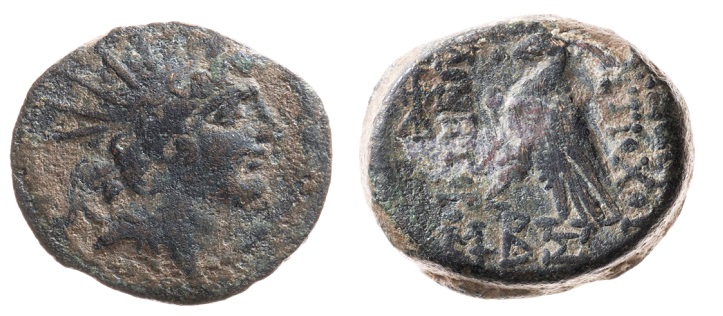
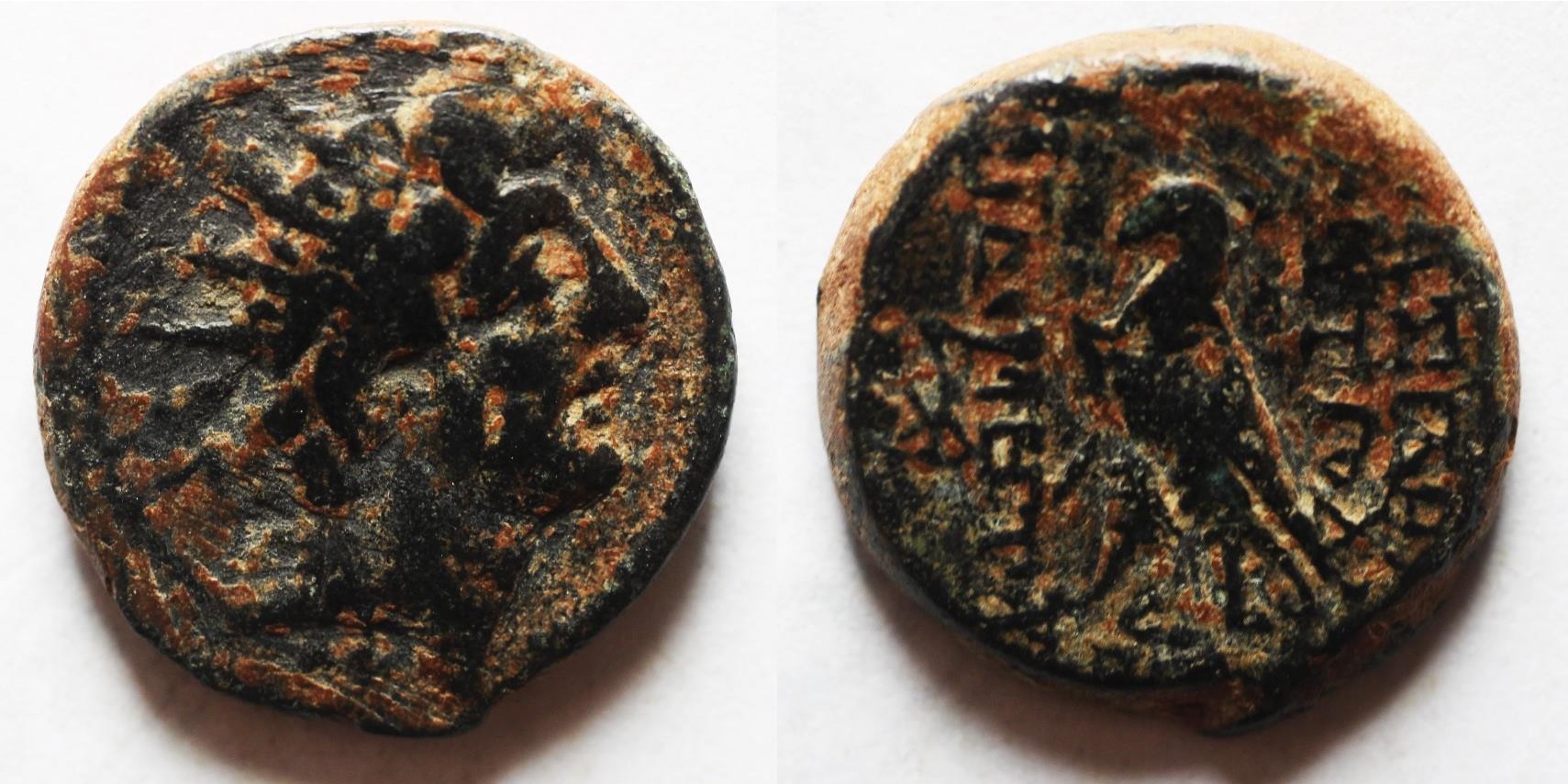
On the total majority of royal coins issued during the sole reign of Antiochos VIII,1 either the epithet Epiphanes (“Illustrious” or “[God] Manifest”) is attached to his name or his name is stated without any epithet. His coins therefore bear either the inscription ‘ΒΑΣΙΛΕΩΣ ΑΝΤΙΟΧΟΥ ΕΠΙΦΑΝΟΥΣ’ or simply ‘ΒΑΣΙΛΕΩΣ ΑΝΤΙΟΧΟΥ’.2 There is only one exception, a small issue of bronze coins minted at Antioch on the Orontes which bear the epithet Philometor (“Mother-loving”):3
|
Obverse: |
Radiate, diademed head of Antiochos VIII right; dotted border |
|
Reverse: |
‘ΒΑΣΙΛΕΩΣ ΑΝΤΙΟΧΟΥ’ in two lines on right, ‘ΦΙΛΟΜΗΤΟΡΟΣ’ on left
(“of King Antiochos the Mother-loving”); eagle standing left, scepter behind
shoulder; control mark in outer left field;4 Seleukid
date ΒΣ (year 202 of the Seleukid Era, i.e. 111/10 BC) in exergue |
This small issue is a part of an extensive
series of bronze coins which was minted at Antioch mint from 121/0 BC (SE 192,
i.e. year 192 of the Seleukid era) to 111/10 BC (SE 202). Coins of this series
have the same design as the coins with the epithet Philometor, but
they bear the standard epithet Epiphanes and they are dated SE
192, ... , SE 200 and SE 202 (coins of this series dated SE 201 are not known).5 Whereas
coins of this series with the epithet Epiphanes are abundant,
the coins bearing the epithet Philometor are rare and they are
known from the year SE 202 only. Moreover, this epithet is not found elsewhere
on Antiochos VIII’s coins.
The epithet Philometor in
itself is strange considering the role of Antiochos VIII in the death of his
mother, Kleopatra Thea:6
Justin, Epitome of the Philippic History
of Pompeius Trogus, 39.2: Grypus (Antiochos VIII),
having thus recovered his father’s throne, and being freed from foreign perils,
found his life endangered by a plot of his own mother (Kleopatra Thea);
who, after betraying, from desire of power, her husband Demetrius (Demetrios
II), and putting to death her other son (Seleukos V, the oldest son
of Demetrios II), was discontented at her dignity being eclipsed by the
victory of Grypus, and presented him with a cup of poison as he was returning
home from taking exercise. But Grypus, having received notice of her
treacherous intention, desired her (as if to show as much respect for his
mother as she showed for him) to drink herself first, and, when she refused,
pressed her earnestly, and at last, producing his informant, charged her with
the fact, telling her, “that the only way left to clear herself from guilt,
was, that she should drink what she had offered to her son.” The queen, being
thus disconcerted, and her wickedness turned upon herself, was killed with the
poison which she had prepared for another.
Appian, Roman History, 11.69: After
Seleucus (Seleukos V, the oldest son of Demetrios II), Grypus (Antiochos
VIII) became king, and he compelled his mother (Kleopatra
Thea) to drink poison that she had mixed for himself. So justice
overtook her at last.
However, as Houghton, Lorber and Hoover mention
in SC II (Vol. 1, p. 502), this epithet was born apparently
without any irony. It is also attested by Eusebius of Caesarea7 and
by an inscription from Delos (ibid, p. 487).
List of known specimens
The following table shows all specimens known to Petr, et al.
The abbreviations A and P stand for Anvil
(obverse) and Punch (reverse) dies but the die identification is tentative
because details are not clearly visible on some coins.

03 Dec 2008, Lot 160.


(c) Hunterian Museum and Art Gallery, University of Glasgow.

(c) Hunterian Museum and Art Gallery, University of Glasgow.






RIC 330 variety
RCV 12670 variety
O: rad, drap, cuir bust r. IMP C G VAL DIOCLETIANVS PF AVG
R: Jupiter r holding orb and spear receiving wreath from Victory, IOVI CON-SERVATOR-IAVG
in ex XXI (possible palm to left?) TR above in field.
slightly different from the types described by Esty Tripolis mint, Roman Empire (augustuscoins.com)
Ex W Esty

RIC 928
Hunter 349-350
O: rad cuir bust r IMP C M AVR PROBVS AVG
R: Probus with scepter receiving orb from Jupiter, CLEME-NTIAT-EMP in ex. KA in lower field a crescent.
ex: W. Esty


